SaaS Programmatic SEO Guide
Learn how to build high-converting programmatic SEO landing pages for SaaS features and integrations with our step-by-step technical growth playbook.

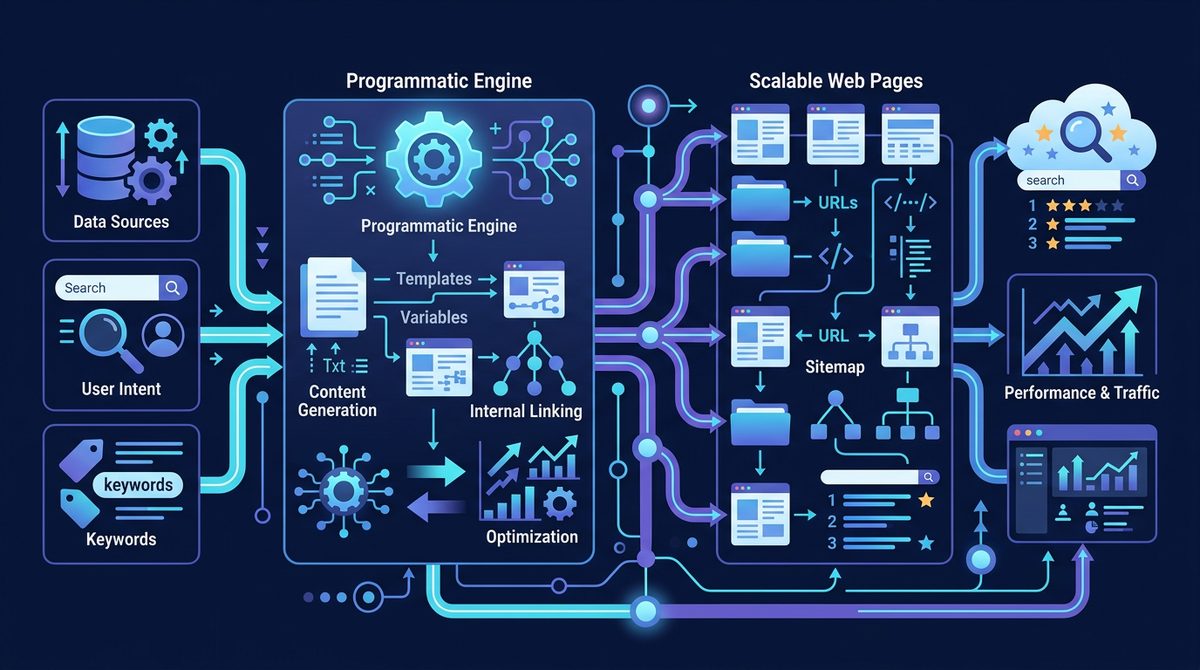
Capturing high-intent organic search traffic in B2B SaaS no longer requires hand-writing hundreds of individual blog posts for every integration or feature permutation. Programmatic SEO allows product teams to publish structured, template-driven landing pages that capture long-tail search queries right when potential buyers are looking for specific software solutions.
When executed correctly, a programmatic SEO pipeline acts as an automated customer acquisition engine. This guide breaks down the technical architecture, data mapping techniques, and conversion optimization strategies needed to scale high-converting SaaS integration and feature pages.
1. Identifying High-Intent Matrix Query Patterns
Programmatic SEO relies on repeatable query patterns where a static modifier combines with dynamic database entities. For B2B SaaS applications, search intent usually peaks across two primary page templates: integration directory pages and workflow/use-case feature pages.
Rather than targeting broad keywords like "project management software," programmatic SEO focuses on transactional, low-volatility matrix queries:
- Integration Pages:
[Your Product] + [Third-Party Tool] + integration(e.g., "Linear Slack integration" or "PostHog Mixpanel import tool") - Alternative/Migration Pages:
[Competitor] + to + [Your Product] + migration - Use-Case Templates:
[Feature] + for + [Industry/Persona](e.g., "CRM for commercial real estate") - Format/Workflow Generators:
[Input File Type] + to + [Output File Type] + converter
By indexing hundreds of long-tail permutations, you capture buyers who have already defined their exact workflow problem and are selecting software to resolve it immediately.
2. Designing the Data Schema and Page Templates
The primary reason programmatic SEO campaigns get penalized or ignored by search engines is thin content duplication. Google’s algorithms easily flag pages that simply swap out a keyword name inside identical paragraphs. To rank consistently, your database schema must store unique structural variables for every single page entity.
| Database Field | Data Type | Purpose & SEO Impact |
|---|---|---|
entity_name |
String | Primary H1 and Title tag injection (e.g., "HubSpot"). |
auth_type |
Enum / Array | Populates technical specifications (OAuth2, API Key, Webhook). |
trigger_actions |
JSON Array | Renders dynamic schema markup and setup steps for specific workflows. |
use_case_quotes |
Text Field | Injects unique, industry-specific customer testimonials or ROI metrics. |
app_category |
String | Builds internal linking hubs across shared software categories. |
Every programmatic page template should combine dynamic database variables with conditional rendering rules. If an integration supports two-way sync, render a visual flow diagram; if it only supports webhooks, output specific step-by-step developer documentation automatically.
3. The Technical Engine: Datasets to Page Rendering
Building an automated programmatic SEO pipeline requires connecting three distinct operational layers: content collection, page generation, and search indexing tracking.
Step 1: Build the Data Engine
Modern growth teams manage programmatic database records using headless content management systems or structured data tools like Airtable, Supabase, or Sanity.io. For software integrations, scrapers or internal API metadata registries can automatically populate available triggers, actions, and OAuth scopes direct from your codebase.
Step 2: Dynamic Static Site Generation (SSG)
Never rely on client-side rendering (CSR) for programmatic pages. Use modern web frameworks like Next.js, Astro, or Nuxt to pre-render static HTML pages at build time via incremental static regeneration (ISR). This keeps page load speeds well below 1.5 seconds while delivering fully rendered HTML directly to search crawlers.
Step 3: Internal Link Graph Architecture
Search crawlers need clear pathways to discover and contextualize dynamic pages. Implement programmatically generated programmatic hubs:
- Parent Category Directory:
/integrations/(Links to all category hubs) - Category Hubs:
/integrations/crm/(Links to individual CRM pages) - Cross-Entity Links: Dynamic "Works Well With" widgets on individual pages (e.g., the HubSpot integration page links to the Salesforce and Stripe pages)
4. Optimization Playbook: Converting Search Traffic into Signups
Traffic alone does not equal ARR. Because visitors landing on programmatic pages enter with tight intent, generic "Sign Up Now" banners lead to high bounce rates. Match your calls-to-action (CTAs) directly to the specific workflow query.
Case Study: Scaling an API Integration Directory
Consider a hypothetical developer analytics tool scaling its integration network. Instead of publishing standard marketing pages, the team configured dynamic landing pages using Next.js and Sanity.io for 150+ software connectors.
"By automatically pulling API endpoint metadata into our integration page templates, we generated 180 unique, schema-optimized landing pages. Instead of generic copy, each page dynamically displayed exact JSON payloads, webhook latency metrics, and setup steps for that specific tool."
The result: Within four months, organic search traffic increased by 310%, and conversion rates from page visits to free trial activations jumped from 1.2% to 4.8%. The hyper-specific technical context matched the visitor's exact developer workflow.
5. Content Quality Controls and Indexation Management
Mass-publishing thousands of programmatic pages simultaneously can trigger quality flags from Google. Maintain indexation health by deploying programmatic quality gates:
- Staggered Deployment: Publish pages in batches of 20 to 50 entities per week. Monitor indexation performance in Google Search Console before scaling to the next batch.
- Enforce Minimum Data Thresholds: Set programmatic rules that prevent pages from rendering if they lack mandatory fields (e.g., if an integration lacks setup steps or direct trigger metadata, automatically set the page header to
noindex). - Automate Schema Markup: Inject structured JSON-LD data on every page (such as
SoftwareApplicationorHowToschema) to help search engines extract feature details directly into rich search snippets.
For workflow automation, software connectors, and analytics setups, tool costs scale with usage. For example, using a headless CMS like Sanity.io (which offers a free starter tier and paid team plans starting around $99/month) paired with hosting platforms like Vercel (Pro tier approximately $20/user/month) keeps infrastructure costs minimal while supporting thousands of static pages. Always verify current pricing details and plan limits directly on the vendor platforms.
Takeaway Checklist for SaaS Founders
Programmatic SEO converts long-tail technical queries into scalable customer acquisition. To build a programmatically driven engine that ranks and converts:
- Mine customer workflows to identify structured, repeatable matrix search patterns.
- Structure your CMS database schema with custom parameters to avoid thin, repetitive text.
- Render static HTML via frameworks like Next.js or Astro to ensure maximum crawlability and fast page loads.
- Connect dynamic, contextual calls-to-action based on the specific software entity searched.
- Monitor crawl health and apply strict quality rules to unpublish thin programmatic records automatically.
Looking to explore the best growth software, analytics stacks, and programmatic tooling for your stack? Browse the SaaSafi tool directory to find top-rated software to scale your SaaS application.
Related reading on SaaSafi
- #saas programmatic seo
- #saas growth
- #programmatic seo
- #b2b saas
- #seo strategy
Frequently asked questions
What is SaaS programmatic SEO?
Programmatic SEO uses database records, static site generators, and programmatic templates to produce hundreds of high-quality, structured landing pages automatically for intent-rich keyword variations.
What tech stack is best for programmatic SEO landing pages?
Modern frameworks like Next.js, Astro, or Nuxt are ideal because they support static site generation (SSG) and incremental static regeneration (ISR) for fast indexing speed and performance.
How do you prevent programmatic pages from being penalized for duplicate content?
Prevent thin content by enforcing rich database schemas, including entity-specific metrics, rendering unique setup workflows, and setting incomplete entries to noindex.
SaaSafi Team
Editorial
Written by the SaaSafi Team — we test and track SaaS tools for founders and operators.
Get the weekly issue
One email a week: new articles, tool teardowns and pricing finds. No spam, unsubscribe anytime.


Comments
No comments yet — start the conversation.