Project Management for Indie Hackers
A practical guide to lightweight, low-friction project management tools designed for indie hackers and solo founders in 2026. Ship faster with less administrative overhead.

Indie hackers don't fail from a lack of complex Jira workflows; they fail because heavy project management software turns into administrative overhead. When you are single-handedly writing code, running customer support, and handling marketing, managing your project management tool quickly becomes a second job. Lightweight project management is about reducing context switching, eliminating unnecessary task attributes, and keeping your momentum high.
The Solo Founder's Dilemma: Velocity vs. Process
traditional project management frameworks assume team division of labor, explicit handoffs, and multi-layered approvals. For a solo operator, sprint planning, story point estimations, and complex epics introduce friction without adding clarity. The goal for an indie hacker isn't total visibility for stakeholders—it is personal velocity and cognitive clarity.
When choosing software as a single-person product team, every feature that doesn't directly speed up execution is a tax. The ideal toolkit combines low-friction issue tracking, seamless documentation, and sensible automation so you can spend less time updating status badges and more time shipping features.
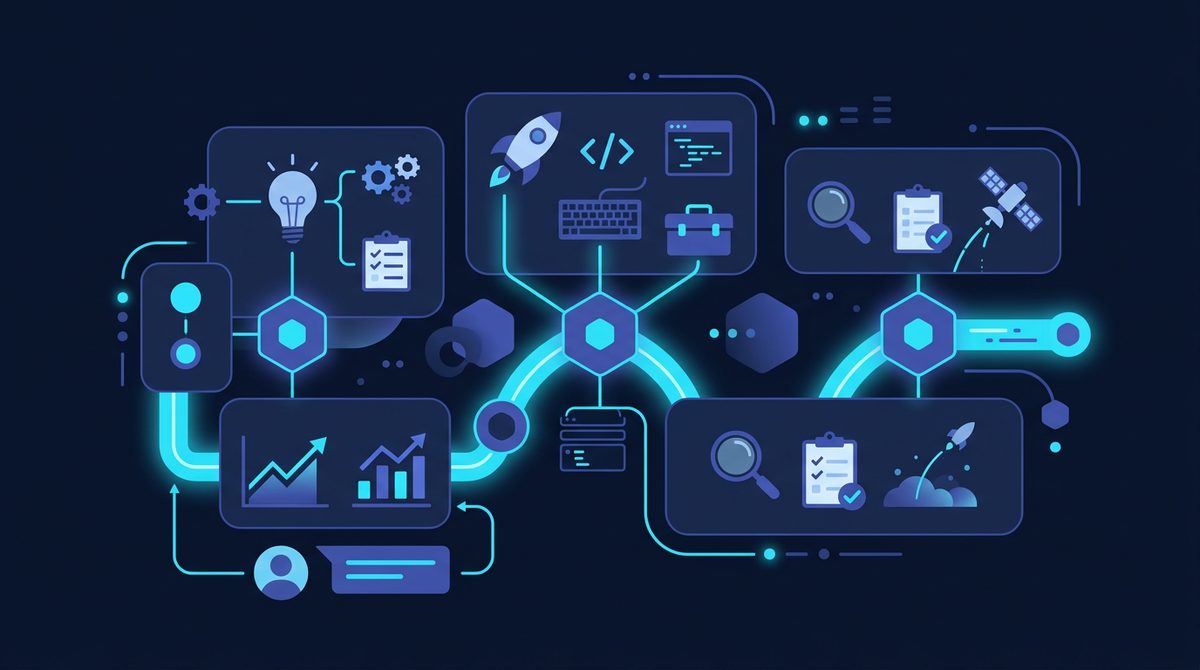
Key Criteria for Lightweight Project Management Tools
Before evaluating specific software, establish a set of strict criteria tailored to solo SaaS builders:
- Instant Capture and Input: Keyboard shortcuts and rapid task creation ensure ideas and bugs are logged before you lose focus.
- Unified Docs and Tasks: Blurring the line between feature specs, API notes, and actionable items prevents endless tab-switching.
- Zero-Config Views: Out-of-the-box Kanban boards or simple lists that require no custom field setup or complicated schema design.
- Minimal Maintenance: No need to run retro meetings, assign story points, or manage sprint velocities just to move an issue to completed.
Top Project Management Tools for Indie Hackers in 2026
Here is a breakdown of the leading lean project management platforms designed to help solo founders ship faster without getting bogged down in process overhead.
1. Linear: Speed and Developer Focus
Linear remains the benchmark for developer-centric issue tracking. It operates with exceptional speed, offers built-in keyboard navigation for almost every action, and seamlessly integrates with GitHub, GitLab, and Sentry. For solo founders who write code daily, Linear turns task management into an extension of the IDE.
Its lightweight "Cycles" feature allows you to bundle work into timeboxes without the rigid rituals of traditional Scrum. Auto-closing issues via git commit messages means your board stays clean without manual intervention.
Approximate Pricing: Free tier available with generous issue limits; Paid plans start around $8 to $10 per user/month. Please verify current pricing and plan details directly on Linear's website.
2. Trello: Pure Visual Simplicity
Trello pioneered the simple visual Kanban board and remains one of the fastest tools for visual thinkers. For founders running simple product launches, content calendars, or high-level roadmaps, Trello’s drag-and-drop card architecture keeps operational friction near zero.
With basic Butler automations, you can auto-archive completed tasks or move items based on due dates, letting you maintain order with minimal effort.
Approximate Pricing: Free plan covers basic needs; Standard and Premium tiers range from $5 to $10 per user/month. Please verify current pricing on Trello's website.
3. Todoist: Rapid Task Capture on the Go
When your main challenge is capturing incoming customer requests, quick bug fixes, and administrative tasks without breaking flow, Todoist excels. Its natural language processing lets you type "Fix Stripe webhook retry logic every Tuesday @dev" and instantly generate a organized task.
While it lacks native Git integration, its simplicity makes it ideal for managing the non-coding operational side of running a bootstrap startup.
Approximate Pricing: Free tier available; Pro plan is approximately $4 to $6 per month. Please check Todoist's official site for current subscription terms.
4. Basecamp (Solo/Personal Workflow): All-in-One Sanity
Basecamp’s philosophy centers on calm company operations. By combining message boards, task lists, docs, and file storage in a single space per project, it eliminates the need to stitch together multiple separate apps.
For indie hackers who want a single repository for product roadmaps, launch checklists, and vendor notes, Basecamp cuts through ecosystem sprawl.
Approximate Pricing: Offers a flat-rate plan for small teams/solos alongside per-user tiers. Check Basecamp's pricing page for the latest updates.
Comparing Lean Management Tools
The following table outlines how these popular solutions fit different operational styles for solo SaaS founders:
| Tool | Best For | Primary Strength | Setup Effort |
|---|---|---|---|
| Linear | Technical Founders / Developers | Keyboard shortcuts, Git links, extreme speed | Low |
| Trello | Visual Thinkers & Marketers | Simple drag-and-drop Kanban boards | Very Low |
| Todoist | Task Capture & Daily Execution | Natural language processing, fast entry | Instant |
| Basecamp | All-in-One Minimalists | Centralized docs, messages, and checklists | Low |
Mini Case Study: How a Solo Founder Ships Weekly
Consider Alex, a solo founder building a micro-SaaS in the analytics space. Initially, Alex set up Jira with custom fields for priority, component, sprint number, and target release. Within three weeks, updating Jira became a chore, leading to abandoned tasks and lost context.
Alex streamlined the workspace by switching to a simple Linear setup paired with GitHub:
- Backlog: Single column for raw ideas and non-urgent fixes, capped at 20 items to prevent bloat.
- Current Cycle: A 1-week cycle containing no more than 3 high-impact features and 5 quick bug fixes.
- Automation: Commits containing
Fixes #123automatically close issues and move them to Done. - Documentation: Feature specs live directly in the issue description or a linked markdown document.
By removing process tax, Alex regained roughly four hours per week previously spent on task organization, resulting in consistent weekly product updates and faster user feedback loops.
Takeaway: Pick the Tool That Gets Out of Your Way
The best project management tool for an indie hacker is the one that requires the least amount of management. Avoid over-engineering your workflows early on. Pick a system that lets you capture ideas instantly, link directly to your code or marketing specs, and clear finished work with minimal friction.
Ready to discover productivity platforms, development frameworks, and automation tools built for modern software builders? Explore our curated directory to find software that speeds up your launch on SaaSafi.app today.
Related reading on SaaSafi
- #indie hackers
- #project management
- #productivity
- #saas tools
- #solo founders
Frequently asked questions
What project management features should a solo founder avoid?
Indie hackers should avoid complex story point estimations, deep epic hierarchies, forced daily standup logs, and excessive custom fields. Focus instead on simple task lists, linear cycles, and auto-closing triggers linked to your codebase.
Is a specialized developer tool better than a general task manager?
It depends on your workflow. If your primary focus is writing code, a dedicated developer tool like Linear reduces context switching. If you handle marketing, design, and operations alongside code, a flexible visual board like Trello or an all-in-one platform may serve you better.
How do I prevent my task backlog from becoming overwhelming as a solo founder?
Set strict WIP limits. Keep your active backlog under 20-30 items, schedule tasks in short 1-week cycles, and aggressively archive or delete low-priority requests that have sat untouched for over a month.
SaaSafi Team
Editorial
Written by the SaaSafi Team — we test and track SaaS tools for founders and operators.
Get the weekly issue
One email a week: new articles, tool teardowns and pricing finds. No spam, unsubscribe anytime.


Comments
No comments yet — start the conversation.