Best AI Marketing Tools for Growth
Scale customer acquisition and automate campaign execution. Explore the best AI marketing tools for SEO, ad creation, and conversion personalization in 2026.

Scaling a SaaS company without increasing your customer acquisition cost (CAC) requires replacing manual campaign creation with deterministic, automated workflows. Rather than relying on generic copy generators, modern growth teams deploy dedicated vertical AI engines designed specifically for paid acquisition, programmatic search engine optimization, and lifecycle personalization. This guide breaks down the high-impact AI marketing stack built to scale user acquisition without bloated marketing headcount.
Evaluating the Modern Growth AI Stack
The landscape of marketing AI has shifted from basic text transformation to proactive execution engines. Today's high-performing growth stacks integrate directly with your product analytics, advertising networks, and CMS pipelines to launch, test, and optimize campaigns autonomously.
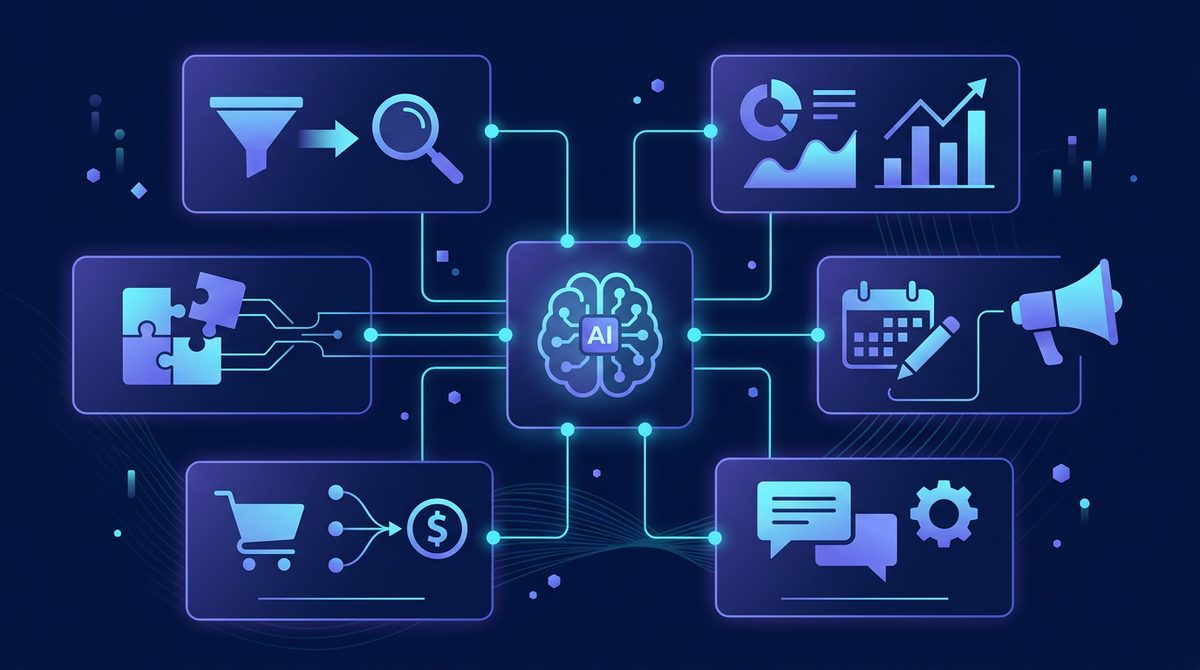
When selecting software for your growth team, evaluate tools across three primary operational categories:
- Programmatic SEO & Content Engines: Platforms that identify keyword clusters, map search intent to dynamic page templates, and publish optimized long-tail content directly to your headless CMS.
- Autonomous Ad Management & Creative Generation: Systems that produce dozens of multi-format ad variants, manage cross-channel budget allocation, and rotate underperforming creative based on live return on ad spend (ROAS) data.
- Conversion Rate & Lifecycle Personalization: Tools that read real-time user intent signals to adapt landing page messaging, optimize sign-up flows, and trigger tailored activation sequences.
Core AI Tools for Acquisition, SEO, and Paid Media
Below is a comparative breakdown of top-performing marketing platforms deployed by growth engineering and demand generation teams.
| Tool Category | Primary Platform | Key Focus Area | Approx. Starting Price |
|---|---|---|---|
| Paid Media Automation | AdCreative.ai | Conversion-focused ad assets & copy variants | ~$29/month |
| Programmatic SEO | SEOwind | Brief creation, outline generation & deep search intent mapping | ~$49/month |
| Search Analytics & Insights | Surfer SEO | Real-time content scoring, NLP optimization & audit workflows | ~$89/month |
| Campaign Execution | Albert.ai | Autonomous cross-channel bidding and creative allocation | Custom enterprise pricing |
| Personalization & CRO | Mutiny | Dynamic web copy personalizations based on firmographic data | Custom enterprise pricing |
Note: Pricing, feature availability, and credit allocation tiers change frequently. Always verify current plan structures on the vendor's official website prior to purchase.
1. Automated Paid Media: AdCreative.ai & Albert.ai
Creating visual creative at scale remains a primary bottleneck for growth teams running paid social and search campaigns. AdCreative.ai leverages trained machine learning models to generate high-converting banner ads, story visuals, and ad copy variants within seconds. By training on vast historical ad performance data, the engine predicts potential click-through rates (CTR) before assets go live.
For large-scale, enterprise paid media budgets, Albert.ai operates as an autonomous media-buying layer. Albert plugs into your Meta, Google, and Bing advertising accounts to process real-time campaign telemetry. It continuously adjusts audience segmentation, shifts budget between top-performing creatives, and executes bid management actions far faster than manual human review allows.
2. Search Engine Optimization: SEOwind & Surfer SEO
Manual keyword research and content brief creation often slow down content velocity. Modern SEO strategies prioritize depth, structural integrity, and search intent precision. SEOwind streamlines the ideation phase by analyzing top-ranking Google SERP results, competitor heading structures, and search questions to build comprehensive content briefs in minutes.
Once content drafts are generated, Surfer SEO provides granular Natural Language Processing (NLP) auditing. Surfer evaluates entity density, structural keyword distribution, and overall topical authority against active page-one competitors. Integrating these tools into a headless CMS workflow allows growth teams to maintain strict editorial standards while scaling content publishing frequency exponentially.
3. On-Site Personalization: Mutiny
Driving qualified traffic to your site is only half the battle; converting cold visitors into product sign-ups requires contextual messaging. Mutiny analyzes incoming IP addresses, firmographic metadata, and referral sources to swap out headline copy, social proof badges, and primary call-to-action buttons in real time.
Instead of sending enterprise software buyers and early-stage startup founders to the exact same home page, Mutiny dynamically tailors the landing page experience. This level of granular targeting dramatically lowers customer acquisition costs without requiring engineering teams to maintain dozens of static landing page URLs.
Execution Framework: Scaling Programmatic Organic Acquisition
To understand how these tools operate in tandem, consider a mid-market B2B SaaS startup looking to scale organic search traffic across 500 specific integration keywords (e.g., "HubSpot to [App] Sync").
Case Architecture: The growth team connects an SEO research engine (SEOwind) to an AI writing pipeline, running output through a automated audit pass in Surfer SEO before publishing to a Webflow CMS via Webhooks.
First, the team feeds their core integration architecture data into SEOwind to map primary search entities and user intent profiles. Next, an automated pipeline parses these outlines, generating deep technical documentation articles tailored to each specific integration workflow. Surfer SEO's API audits the programmatic output to confirm target entity coverage matches top-ranking benchmark standards.
By connecting this workflow directly to their CMS, the startup deploys 150 deeply technical, high-intent programmatic landing pages in under three weeks. Rather than waiting six months for manual agency delivery, the team captures long-tail search volume rapidly, driving qualified demo requests at a fraction of standard agency execution costs.
Strategic Takeaways for Growth Teams
Integrating AI into your growth strategy isn't about automating spam; it's about eliminating manual operational friction across creative production, research, and distribution. When deploying these tools, keep three core rules in mind:
- Maintain Human QA Layers: Never push raw AI output directly to production without a quick editorial or brand review step to protect site quality and domain authority.
- Focus on Closed-Loop Telemetry: Ensure your creative and SEO tools continuously ingest actual conversion data, not just surface-level engagement metrics.
- Automate Iteration, Not Just Initial Creation: Use AI tools to generate 20 iterative variations of proven winning ad angles rather than throwing disparate concepts at ad networks.
Ready to evaluate top-rated marketing platforms, content automation layers, and analytics suites for your company? Browse our curated directory of vetted SaaS tools and AI solutions on SaaSafi to upgrade your marketing stack today.
- #ai marketing tools
- #growth hacking
- #programmatic seo
- #paid acquisition
- #saas marketing
Frequently asked questions
How do I decide which AI marketing tool to adopt first?
Focus on high-leverage bottlenecks first. If ad creative output is your primary constraint, start with an image and ad copy engine. If organic acquisition is your primary driver, implement programmatic SEO research and scoring platforms before branching into video or interactive tools.
Will using AI content tools harm my site's organic search rankings?
Generative tools streamline production, but sustained search rankings require topically rich, accurate, and original insights. Always route raw AI drafts through subject-matter experts for technical accuracy, brand tone, and unique perspective to satisfy search engine quality guidelines.
Do these tools require custom developer resources to integrate?
Modern AI marketing platforms utilize pre-built API integrations and Webhooks to connect directly with popular CRMs, headless CMS platforms, and ad networks like Google, Meta, and LinkedIn without heavy custom engineering support.
SaaSafi Team
Editorial
Written by the SaaSafi Team — we test and track SaaS tools for founders and operators.
Get the weekly issue
One email a week: new articles, tool teardowns and pricing finds. No spam, unsubscribe anytime.



Comments
No comments yet — start the conversation.