How to Build an AI SaaS in 2026
A practical guide for non-technical founders on building and launching a profitable AI SaaS in 2026 using visual builders, visual backends, and model APIs.

Building an AI-powered SaaS no longer requires a team of machine learning engineers or deep technical knowledge. With modern visual application builders, orchestration engines, and pre-trained model APIs, non-technical founders can go from concept to a revenue-generating product in a matter of weeks. The real challenge in 2026 isn't training models; it's orchestrating workflows, managing API margins, and delivering immediate product value.
The 2026 AI SaaS Tech Stack for Non-Technical Founders
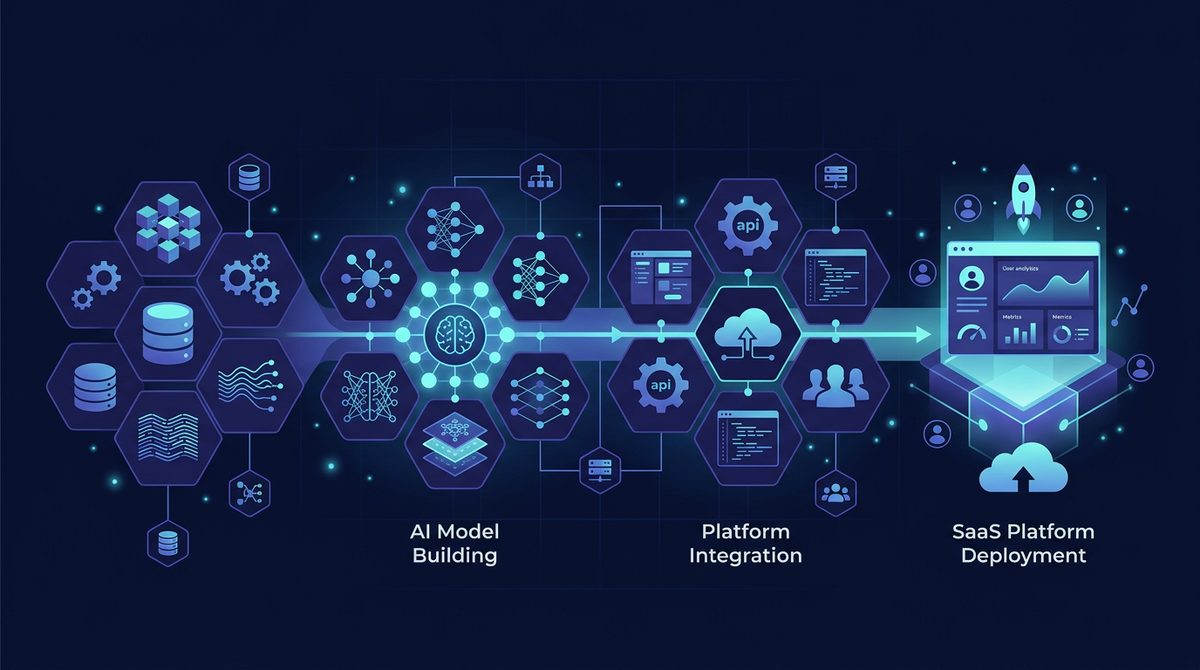
To launch a scalable AI application without writing backend code, you need four key layers: the user interface, the visual backend logic, the database, and the model orchestration layer. Modern visual development platforms handle authentication and state management out of the box, allowing you to focus entirely on user experience and prompt architecture.
Instead of wrestling with complex codebases, non-technical operators combine specialized visual tools to form a robust production stack. Here is a breakdown of the leading non-code stack components used by top indie founders today.
| Layer | Recommended Tools | Primary Role | Approximate Starting Cost |
|---|---|---|---|
| Frontend App Builder | Bubble, FlutterFlow, WeWeb | User interfaces, auth, client-side logic | $29 - $70/month |
| Workflow Backend | BuildShip, Fastgen, Xano | Visual backend endpoints, API secret management | $0 - $50/month |
| AI Orchestration | Langflow, Flowise, Vercel AI SDK | Prompt chaining, vector search, RAG pipelines | Self-hosted (Free) or $20/month cloud |
| Database & Vectors | Supabase, Pinecone, Qdrant | User data storage and semantic vector embeddings | $0 - $25/month base tier |
Note: Pricing structures and plan limits change frequently. Be sure to verify current pricing directly on each vendor's website.
Step 1: Architecting Your AI Value Proposition
The most common failure mode for AI startups in 2026 is building a thin wrapper over a base LLM model like Claude 3.5 Sonnet or OpenAI's GPT-4o. If a user can achieve the exact same result by pasting a prompt into ChatGPT, your app lacks a defensible moat. You must provide context, structured inputs, and automated downstream actions.
Your product must solve a specific, high-friction problem for a well-defined audience. Sustainable AI applications generally combine three operational elements:
- Proprietary Context: Integrating user domain data via Retrieval-Augmented Generation (RAG) or custom database connectors.
- Structured Input Workflows: Replacing open-ended chat boxes with guided forms, drop-downs, and file upload fields tailored to specific job roles.
- Executable Outputs: Going beyond raw text generation to produce formatted PDFs, synced CRM updates, or automated Webhook payloads.
Step 2: Designing Your Visual Backend & Model Chains
Once your visual interface is set up in tools like Bubble or WeWeb, you need a backend to execute LLM calls without exposing private API keys. Visual backend engines like BuildShip or Fastgen allow you to build custom REST API endpoints using drag-and-drop nodes.
For applications requiring context retrieval—such as analyzing long contracts or searching internal documentation—you will implement a simple RAG pipeline. When a user uploads a file, your backend generates text embeddings using an API from OpenAI or Cohere, stores those vectors in Pinecone or Supabase Vector, and queries them whenever the user sends a prompt.
Key Architecture Rule: Never call model APIs directly from your web frontend. Always route calls through a visual backend or edge function to securely store API keys, handle rate limits, and calculate token usage per user.
Mini Case Study: How "LegalBrief AI" Launched in 14 Days
To see this architecture in action, consider LegalBrief AI, a niche B2B tool built by a solo founder with zero coding background. The tool analyzes commercial lease agreements and flags tenant risk factors.
The founder built the frontend using WeWeb, providing legal teams with a clean drag-and-drop portal for contract uploads. When a contract PDF is submitted, Xano triggers a workflow that extracts text, splits the document into chunks, and runs those chunks through an Anthropic Claude API prompt configured specifically for legal compliance risk matrixes.
The structured response is sent back to WeWeb as formatted JSON, populating an interactive risk dashboard. By leveraging off-the-shelf visual tools, the founder launched a beta version in under two weeks for less than $150 in initial tool costs and secured 12 paying law firm accounts within the first month.
Step 3: Managing Costs and API Unit Economics
Unlike traditional SaaS where gross margins routinely sit above 80%, AI SaaS products incur variable token costs for every user action. Managing your unit economics from day one is essential to avoid negative margins.
Implement strict usage tiers instead of unlimited seats. Charge users based on monthly usage credits or token allocations, and cache frequent queries using tools like Redis or Upstash to avoid paying for duplicate model calls. For standard text-processing tasks where reasoning overhead is minimal, route requests to smaller, cheaper models like GPT-4o-mini or Claude 3 Haiku to keep server costs low.
Takeaway: Execution Trumps Model Ownership
Building an AI SaaS in 2026 is no longer about who has the biggest machine learning budget. The playing field has been flattened by accessible, highly reliable visual tools and model APIs. Your competitive edge lies in deeply understanding user workflows, designing seamless interfaces, and delivering tangible business outcomes.
By pairing frontend app builders like Bubble or FlutterFlow with visual backends and smart prompt chaining, you can build, launch, and monetize a enterprise-grade software product independently. Ready to assemble your stack? Explore top-rated visual builders, backend services, and AI APIs in our curated directory.
- #ai saas
- #no-code
- #founders
- #visual dev
- #product design
Frequently asked questions
Do I need to know how to code to build an AI SaaS in 2026?
Do I need to know how to code to build a competitive AI SaaS in 2026?
How do I prevent users from burning through my API token limits?
Non-technical founders can build production-ready applications using visual builders like Bubble, FlutterFlow, or WeWeb paired with visual backends like BuildShip or Xano. You only need a strong grasp of logic, API requests, and prompt engineering.
What is the average cost to build and launch an AI SaaS MVP?
Set hard usage caps based on paid tiers, implement credit-based billing, use smaller models for simple tasks, and cache responses for repeated user inputs. Always route requests through a secure backend layer to monitor usage per user.
SaaSafi Team
Editorial
Written by the SaaSafi Team — we test and track SaaS tools for founders and operators.
Get the weekly issue
One email a week: new articles, tool teardowns and pricing finds. No spam, unsubscribe anytime.



Comments
No comments yet — start the conversation.