AI Workflow Automation Tools for SaaS
Learn how early-stage SaaS teams leverage low-code AI workflow automation tools to streamline operations, route context, and build intelligent workflows without technical debt.

The Operational Bottleneck of Early-Stage SaaS
Early-stage SaaS teams rarely fail because of a lack of ambition; they stall because technical founders end up acting as manual router nodes for routine operational tasks. Processing inbound lead context, triaging bug reports, validating customer refund requests, and enriching CRM data drain engineering capacity faster than technical debt. Low-code AI workflow automation solves this by inserting Large Language Models directly into execution pipelines, turning messy unstructured inputs into structured, predictable actions.
Rather than relying on basic visual automation builders that pass static JSON payloads across webhooks, modern AI orchestration engine platforms allow non-engineers to embed non-deterministic decision logic into core business operations. These engines parse unformatted text, evaluate conditional logic using custom system prompts, and execute downstream API calls without developer intervention.
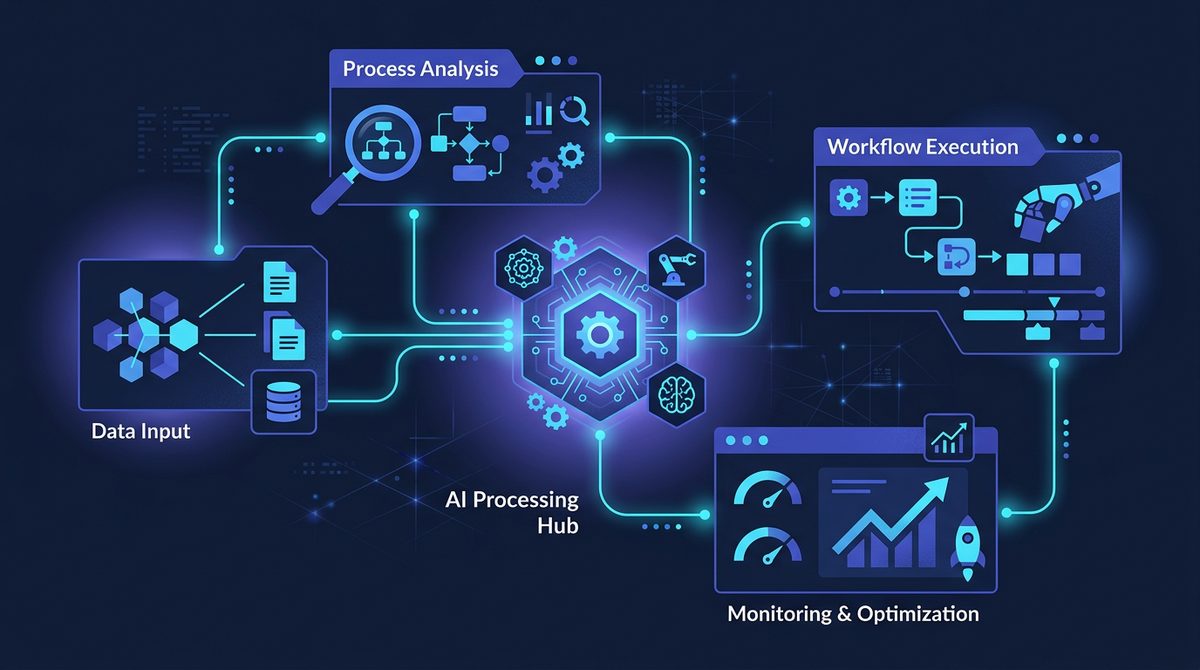
Anatomy of an AI-Driven Workflow Architecture
A resilient AI automation pipeline consists of four distinct architectural layers. Moving away from rigid, multi-branch conditional trees, modern AI workflow platforms handle edge cases through probabilistic reasoning rather than hardcoded rules.
- Trigger & Ingestion Layer: Listens for native events via webhooks, inbound emails, database CDC (Change Data Capture) feeds, or API calls from product analytics tools.
- Context & Enrichment Layer: Queries internal databases (such as Postgres or Vector stores) or third-party APIs (Clearbit, Apollo) to ground the incoming payload in company-specific context.
- AI Reasoning Engine: Passes the enriched prompt to an LLM (such as OpenAI GPT-4o, Anthropic Claude 3.5 Sonnet, or fine-tuned open-source models) alongside structured output schemas (JSON Mode or Pydantic definitions).
- Action & Routing Engine: Takes the validated, structured output and dispatches execution payloads to downstream destinations like HubSpot, Slack, Linear, or custom internal webhooks.
Core Low-Code AI Automation Platforms Compared
Selecting the right engine depends on your data residency requirements, technical comfort level, and structural complexity. Below is how the leading AI workflow platforms stack up for SaaS operational builds in 2026.
| Platform | Primary Strengths | AI Integration Style | Deployment Model | Approx. Starting Price |
|---|---|---|---|---|
| n8n (Self-Hosted/Cloud) | Source-available, custom code nodes, complex data structures | Native LangChain nodes, native vector store connectors, direct LLM endpoints | Cloud or Self-Hosted Docker | $20/mo (Cloud) or Free (Self-Hosted) |
| Make | Visual builder, extensive SaaS connector ecosystem | Native OpenAI & Anthropic modules, JSON transformation parsers | Managed Cloud | $9/mo (Core plan) |
| Flowise / Langflow | Visual AI agent graph builders, RAG architecture visualizer | Native LLM orchestration, agent chains, memory vectors | Self-Hosted or Cloud Managed | Free (Open Source) / Managed tiers varies |
| Relay.app | Human-in-the-loop approvals, deep Google/Slack integrations | Inline AI text extraction, summarization, classifier steps | Managed Cloud | $18/mo |
Note: Vendor features, execution quotas, and usage tiers change frequently. Please verify current pricing and plan limits directly on the vendor's website.
Real-World Operational Playbook: Automated Tier-1 Lead Qualification & Enrichment
Consider a standard early-stage SaaS workflow: A potential client submits a high-intent contact request on your marketing site. A human sales engineer typically spend 15 minutes reviewing the company, researching funding and tech stack, and writing a tailored response. Here is how an AI workflow automates this entirely within 10 seconds.
Step 1: Webhook Ingestion & Context Fetching
The form submission fires a webhook to n8n or Make. The payload contains the prospect's work email and a free-text message detailing their problem. The workflow immediately triggers a Clearbit API call using the email domain to retrieve company size, industry classification, estimated revenue, and current tech stack.
Step 2: Structured AI Classification & Scoring
The workflow passes the submission message and enriched data to Claude 3.5 Sonnet via an API node with a strict JSON schema enforcement prompt. The LLM is instructed to extract key metadata:
Prompt Target Output Schema:
{ "buying_intent": "high" | "medium" | "low", "primary_use_case": string, "churn_risk_from_competitor": boolean, "suggested_routing": "AE_Demo" | "Self_Serve_Docs" | "Nurture" }
Step 3: Action Execution & Human-in-the-Loop Safeguards
If the AI determines buying_intent is "high" and company size is greater than 50 seats, the pipeline generates a customized demo prep brief, posts a structured card inside the #sales-pipeline Slack channel with a single-click "Approve & Send Outreach" button, and drafts an personalized reply in Outreach or HubSpot. If approved, the email dispatches automatically.
Building Resilient Workflows: Avoiding Common Failures
Deploying AI agents and non-deterministic logic into business workflows introduces operational risks that standard visual automations avoid. Implement these architectural safeguards early:
1. Always Enforce Structured JSON Schema Outputs
Never accept raw unstructured string responses from an LLM node inside an automation workflow. Rely on function calling or schema enforcement features (like OpenAI JSON Mode or Zod validation in custom JavaScript nodes) to ensure down-stream API nodes receive predictable input types.
2. Set Deterministic Fallbacks and Circuit Breakers
Model latency, rate limits, or context window limits will occasionally break LLM execution nodes. Build fallback branches that trigger standard visual logic (e.g., routing to a human queue or logging raw inputs to PostgreSQL) whenever the AI step returns a non-200 code or fails schema validation.
3. Implement Cost and Token Monitoring
Uncapped recursive loops inside AI agent visual builders can exhaust API credits in minutes. Enforce explicit step execution caps, monitor token counts per run, and use smaller, faster models (like Claude 3 Haiku or GPT-4o-mini) for simple categorization or extraction tasks before escalating to heavy reasoning models.
Takeaway: Automate Ops so Technical Founders Can Focus on Product
Low-code AI workflow tools have transformed business process automation from simple data translation into intelligent operational execution. By offloading lead triaging, contextual support routing, and internal data transformation to low-code AI pipelines, lean SaaS teams can achieve the operational output of a far larger company without bloating headcount.
Ready to upgrade your stack with modern automation builders, AI agents, and developer tools? Browse through the SaaSafi directory to explore, compare, and implement top-rated SaaS tools designed for high-growth operations.
- #ai tools
- #workflow automation
- #saas operations
- #no-code
- #low-code
Frequently asked questions
How do AI workflow automation tools differ from traditional visual automation builders?
Standard low-code tools like traditional Zapier rely on static, deterministic visual steps (if X triggers, pass Y field to Z app). AI workflow tools embed probabilistic LLM nodes that can process unstructured data, make nuanced classification choices, generate context-aware text, and transform variable formats dynamically during run-time.
How can SaaS teams prevent operational errors from non-deterministic AI outputs?
The most effective way is implementing strict JSON schema outputs or function calling features, coupled with programmatic runtime validators (like Zod or JSON Schema nodes). If an LLM response fails validation, the workflow routes to a deterministic fallback path or a human review queue.
Are low-code AI workflow engines secure enough for sensitive SaaS customer data?
Self-hosted, open-source options like n8n or Langflow allow you to keep operational execution entirely within your virtual private cloud (VPC). You can direct processing requests to enterprise LLM providers with strict zero-data-retention agreements or run local open-source models using Ollama or vLLM.
SaaSafi Team
Editorial
Written by the SaaSafi Team — we test and track SaaS tools for founders and operators.
Get the weekly issue
One email a week: new articles, tool teardowns and pricing finds. No spam, unsubscribe anytime.



Comments
No comments yet — start the conversation.